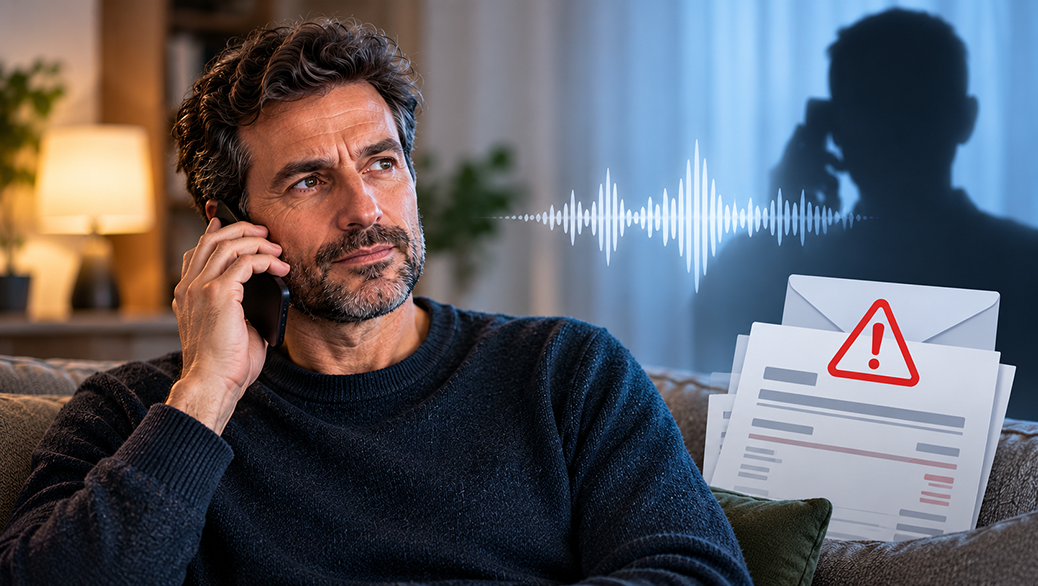
Maybe you’ve heard the warning: never say “yes” on the phone, or you’ll suddenly find yourself stuck with a contract. The scammers supposedly just snip out your “yes” and splice it in after a made-up question – and before you know it, you’re being asked to pay up.
Sounds alarming. But does the story hold up under scrutiny?
The warning that’s making the rounds everywhere
The story goes roughly like this: the phone rings, a friendly voice asks “Can you hear me okay?” or “Is this Mr. Smith?” You answer with a reflexive “yes.” And that very “yes,” so the tale goes, gets recorded, ripped out of context and later used as your supposed agreement to a contract. Weeks later a bill lands in your mailbox, and if you don’t pay, the threat of debt collection follows.
This warning has been circulating for years – in chain emails, in group chats, in conversations over coffee. It’s so widespread that some people become genuinely afraid to utter a simple “yes” on the phone, frantically searching for ways to avoid saying it instead.
That’s understandable. But if you actually think the story through calmly, what’s left at the end is a far more reassuring conclusion.
The obvious question: how is this even supposed to work?
Let’s take the claim at face value. A caller is supposed to record your “yes,” cut it out of the conversation and splice it in after a question that was never asked – something like “Would you like to sign up for our premium package at $49.90 a month?” Then they present this doctored recording as “proof” that you agreed to a contract.
The whole story hangs on that splice – and that’s exactly where its logical flaw lies. A forgery can fake agreement, but it can never create it. It’s like a forged signature: it may look real and fool you for a moment, but it doesn’t create a contract, because you never agreed to anything. It’s no different with a doctored recording.
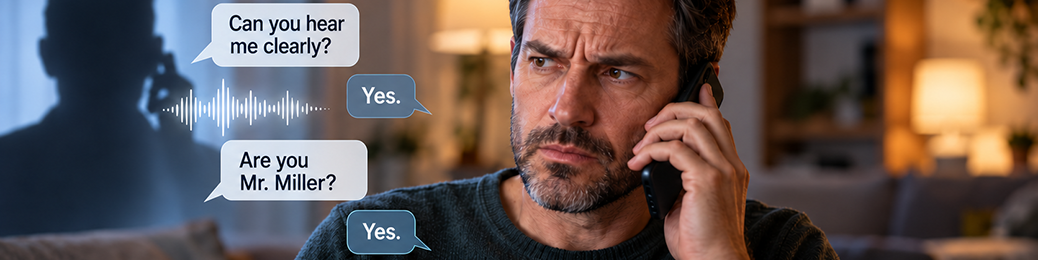
Why “Yes, I can hear you” isn’t a contract
A contract comes about through agreement to specific terms. It requires a particular offer, a price, a service, a term – in short, a recognizable intent to be bound by exactly those conditions. A doctored recording cannot conjure up that intent. It can create the impression that you agreed to an offer that was never actually presented to you – but an impression isn’t the thing itself.
As a side note: someone who invents claims won’t be deterred by whether recording a call is legal in the first place. What matters is that a forgery cannot create agreement, no matter what country you’re in.
What it’s really about: intimidation, not proof
To avoid any misunderstanding: the scam is real. There are real victims who found unjustified bills in their mailboxes after such calls, and many of them were expected to pay for services they never ordered. It’s just that the fraud works differently than the “yes” warning suggests.
Because what the scammers are after is not proving a contract in court. It’s intimidation. The business model consists of sending out an invented bill, dressing it up with a threatening backdrop – “demand for payment,” “final notice,” “referral to a collection agency” – and hoping that a portion of the people called simply pay out of fear and uncertainty.
This is where the doctored recording earns its keep. It creates no legal obligation – but it can still fool and pressure someone, and that’s the whole point of it. It’s a prop in a bluff, a legend meant to make victims believe there really is some kind of proof. The math is purely statistical: whoever sends a thousand such letters and succeeds with even a small percentage is turning a profit. The real weapon isn’t the word “yes,” it’s the panic they trigger in the recipient.
Paradoxically, the warning that you must never say “yes” actually plays right into this scam: it keeps alive the very fear the scammers profit from.
Staying silent doesn’t make an invented bill real
An unjustified claim doesn’t become justified just because you don’t immediately object to it. If you never agreed to the purchase, a doctored recording doesn’t make you liable for it – the decisive thing is genuine consent, not whether you confirmed anything afterward. And not disputing a made-up bill is not an acknowledgment that you owe it. For consumers, unordered goods or services generally create no obligation to pay.
Above all, this means one thing: you don’t have to tense up on the phone. You’re allowed to say “yes.” You’re allowed to answer “yes, I can hear you fine,” without fear of having accidentally concluded a contract. That little word is harmless.
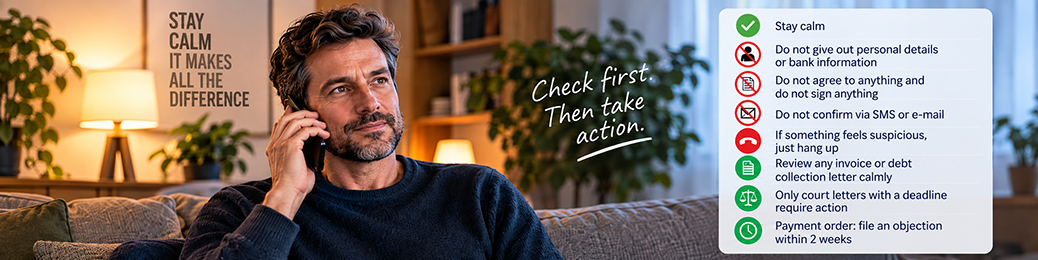
What actually matters
Since a bit of healthy caution on the phone never hurts anyway, here’s what actually counts – beyond the “yes” myth. Stay calm: don’t confirm any personal details or bank information on the phone, don’t give out your account number, date of birth or anything else that someone could actually put to use. Don’t agree to anything, and don’t confirm anything that gets sent to you afterward by text or email to “verify.” And if a call feels strange, or the conversation seems designed to coax specific answers out of you, just hang up. You don’t owe an unsolicited caller your time.
If a bill or a collection letter later arrives for something you never ordered, don’t panic. As a consumer, you don’t have to respond to it in order to owe nothing: your silence creates neither a contract nor an acknowledgment of debt, and a payment deadline that the sender of a made-up bill sets for you has no power to turn that bill into a real debt.
That said, “you owe nothing” is one thing, and “it can still be worth exercising certain rights within a deadline” is another. Some jurisdictions attach real consumer rights to acting in time. In the United States, for example, federal law (the Fair Debt Collection Practices Act) gives you a window: if you dispute the debt in writing within 30 days of the collector’s first notice, the collector generally must pause collection until it sends you verification of the debt. Elsewhere, other deadlines can matter for different reasons. So disputing in writing is worth considering – it often puts the matter to rest early and can preserve rights you’d otherwise lose – but it’s a recommendation, not an obligation, and not a prerequisite for owing nothing.
There is, however, one kind of mail you really do have to take seriously: a summons or other official court documents. These are not empty threatening letters. Deadlines for responding to court documents are strict and can be short, and once such a document is properly served, the clock starts running whether you like it or not. If you don’t respond in time, a court can enter a judgment against you by default – a “default judgment” – even for a claim that was never justified in the first place. That’s exactly why responding on time is so important.
The distinction is easy to remember: an unjustified bill or a collection letter may sound unpleasant, and it may even come with rights worth exercising in time, but the deadline the sender prints on it can’t create a debt on its own. Official court documents are a different matter – those you must not put off.
Bottom line: the danger isn’t the word, it’s the fear of it
The warning “never say yes on the phone” means well, but it misses the point. A doctored recording can fake agreement, but it can’t create it – any more than a forged signature creates a contract. It can still be used to deceive and pressure you, and that, not the word “yes,” is where the real fraud lives: in the uncertainty of the people being called.
Once you’ve seen through that, you can speak freely on the phone again. Stay calm, don’t hand over sensitive information, don’t agree to anything, treat unjustified claims with composure – and save your urgency for official court documents, where a deadline really is running. Panic isn’t part of the equation.
Have you ever gotten a call like this or a dubious bill yourself? Tell us about it in the comments – your experience helps other readers spot the scam.
Comments
Everyone who knows me AND need to contact me know my email address. They also know that, due to the work I do (and my personal preferences), I will not answer a phone call. My phone is for emergencies. That's it.
As to the U.S. "Do not call list" -- there are two ways to reliably get on that. The first is to request it when you get a call from a newspaper, because they put you on a distributed master list. The second is an angry, "I'm *supposed* to be on your Do Not Call list!" (which gets you on the list stat, because there are fines for violations).
* - I suppose nothing is 'always'! - but near enough.
Yesteryear blocking a number was fine as scammers only used numbers not in service but now they can spoof a number that is real and currently in use. You may find you've blocked a number that you need a call from.
If you end up answering a scam call the best bet is to ask, "What is this call in regards to?" and then lie, lie lie.
Them: "We're calling about your car insurance." You (lying): "I don't own a car"
Them: "We're calling about your Senior Citizen Medicare coverage." You (whether you're lying or not): "What Senior Citizen coverage, I'm only 30."
Giving them this information can make them believe they have gotten erroneous information and could very well get you off the list.
Unless, of course, you just tell them to talk to the dog and put the phone on the floor and tell your dog to bark at it. That can be quite satisfying.
I used to keep a police whistle by the phone, but stopped because it was unkind.
I find it important to point out that, even if they claimed you said "yes" to a contract, any contract made on a phone can be canceled within a certain time frame, depending on the legislation in your country.