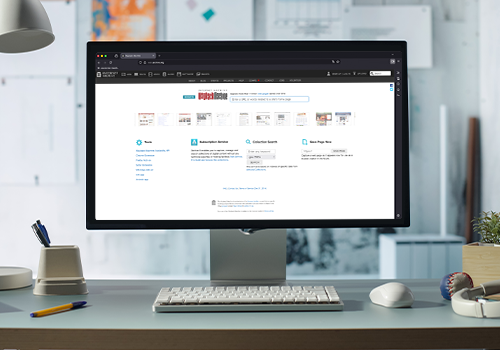
Do you remember the internet of the ’90s? The blinking GIF animations, guestbooks, hit counters and websites that looked like digital yard sale flyers? What was cutting-edge back then feels like a relic from another era today.
But the old web hasn’t vanished – it’s been archived. Projects like the Wayback Machine from the Internet Archive, the Digital Public Library of America and countless other digitization initiatives preserve what would otherwise be lost forever. They make digital time travel possible – and it’s equal parts fascinating, educational and entertaining.
The Wayback Machine: More than 1 trillion web pages archived
The Wayback Machine (web.archive.org) is by far the best-known and most comprehensive web archive in the world. It’s operated by the Internet Archive, a nonprofit organization based in San Francisco that was founded by Brewster Kahle in 1996. The idea was as simple as it was visionary: the internet forgets – so someone needs to make sure it remembers.
Today, the Wayback Machine contains over 1 trillion archived web pages. That amounts to hundreds of petabytes of data. Automated crawlers scan the web at regular intervals and save snapshots of websites. Popular sites get archived more frequently than obscure ones; some pages exist in hundreds of versions, others in just one.
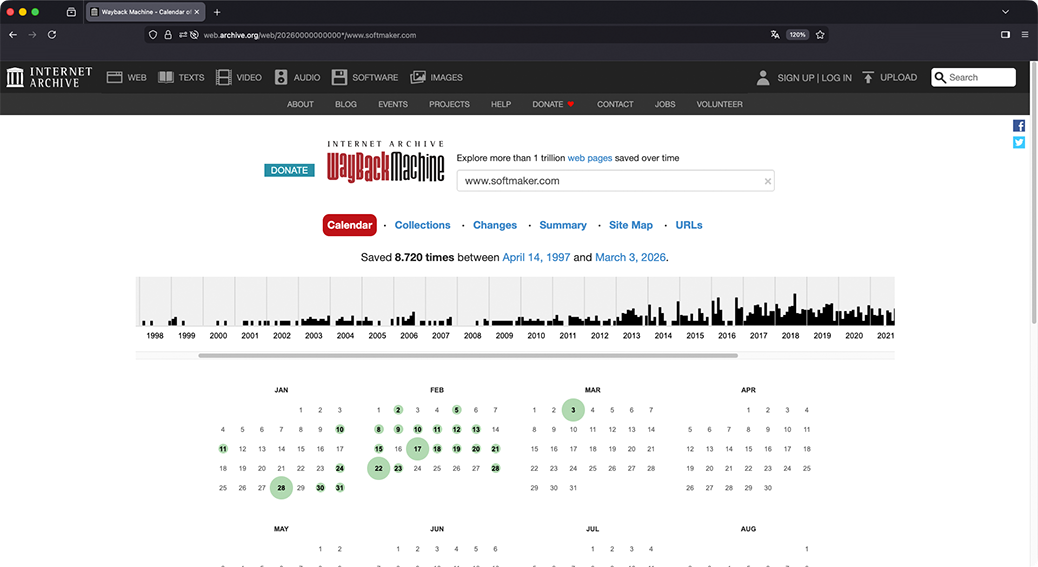
Using it couldn’t be easier: enter a URL into the search bar and you’ll get a calendar showing which days a snapshot of that page was captured. Click on a date and the page opens exactly as it looked back then – complete with graphics, links and often even working CSS.
Want some examples?
- google.com in 1999: A bare-bones page with the Google logo, a search box and the note “Copyright ©1998 Google Inc.” – no Gmail, no Maps, no Android.
- amazon.com in 1999: An online bookstore with recommendations on the homepage and the slogan “Earth’s Biggest Bookstore.”
- nytimes.com in 2000: Table-based layout, tiny fonts, news in plain text – no video, no live blog.
But the Wayback Machine is far more than a nostalgia toy. Journalists use it to verify deleted statements by politicians. Researchers study the evolution of web design and online communication. Lawyers rely on archived pages as evidence. And companies can trace how their own web presence has changed over the years.
A look back: what software websites used to look like
The Wayback Machine entries of software companies are especially revealing. Click through the archives and you’ll experience in fast-forward how not just web design, but the entire software industry has transformed.
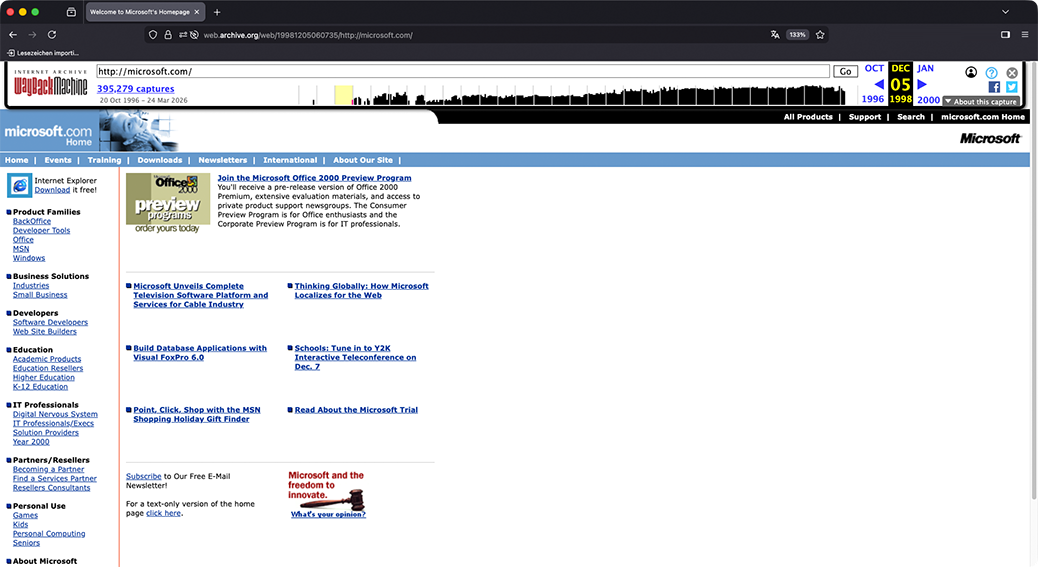
Take microsoft.com from 1996 as an example: the site promoted Windows 95 and Internet Explorer 3.0. Downloads were measured in kilobytes, and the notice “Best viewed with Internet Explorer” wasn’t ironic – it was dead serious. Software was sold on CD-ROMs and purchased at retail stores – the idea of subscribing to an Office suite over the internet was still the stuff of science fiction.
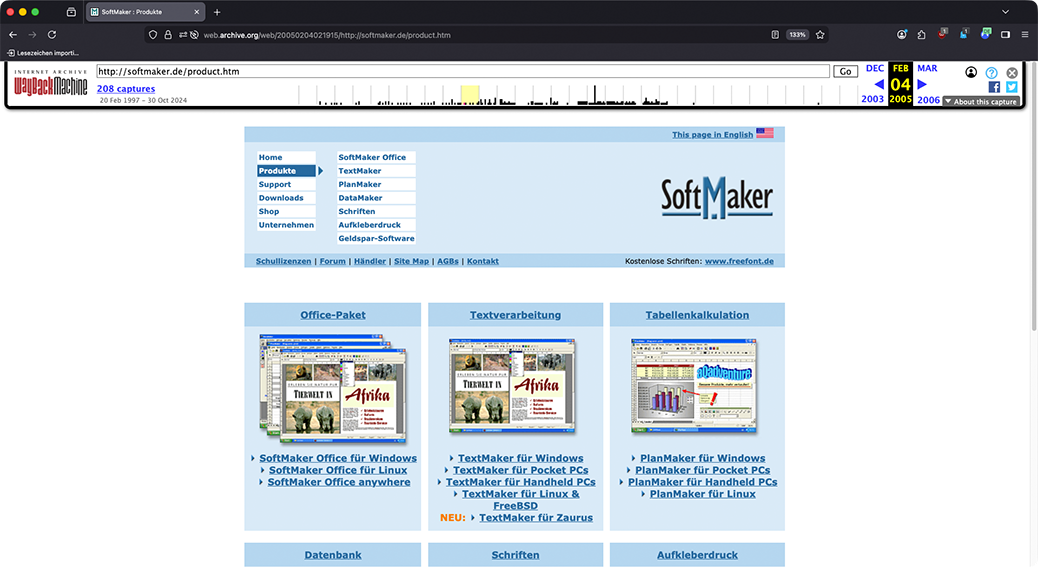
The SoftMaker website can also be traced back to the late ’90s through the Wayback Machine. Where today a modern design with ribbons and screenshots showcases the power of SoftMaker Office, you’d have found simple product listings and text on a white background. The feature set was different, of course – but the goal was the same even then: to offer a powerful, affordable and user-friendly alternative to Microsoft Office.
What stands out most when browsing old software websites is this: the industry has transformed at a breathtaking pace. One-time purchases gave way to subscriptions, floppy disks to download platforms. Some companies rode these waves; others disappeared. Names like Lotus, Borland or Corel were once giants of the software world – today, hardly anyone remembers them.
More than just web pages: the Internet Archive as a digital library
The Wayback Machine is just one part of the Internet Archive. The organization archives far more than websites:
- Books: Over 37 million texts, including scanned books that can be borrowed through the “Open Library.”
- Audio: Millions of music recordings, podcasts, radio broadcasts and audiobooks – including the famous “Grateful Dead Collection” with over 17,000 concert recordings.
- Video: Movies, news broadcasts, documentaries – much of it in the public domain and freely accessible.
- Software: A massive collection of old programs, many of which can be run directly in your browser – including MS-DOS games, early Windows applications and historic operating systems.
That last one is especially exciting for tech enthusiasts: using the built-in DOSBox emulator, you can play classics like Oregon Trail, Prince of Persia or SimCity right in your browser – no installation required. You can also try out old productivity software like WordPerfect 5.1 or Lotus 1-2-3. Anyone who ever worked with these programs will remember the blue screens and the keyboard shortcuts.
American digitization projects: preserving the heritage
Beyond the Internet Archive, the United States is home to major digitization projects that preserve historical documents and cultural treasures for future generations:
The Digital Public Library of America (dp.la) connects thousands of libraries, archives, museums and cultural institutions across the country. It offers access to millions of digitized books, images, recordings, films and other materials – all free of charge.
The National Archives preserves the historical documents of American government – from the Declaration of Independence and the Constitution to military records, immigration documents and presidential papers. Photographs, films, maps and posters are accessible online and provide a unique window into the nation’s past.
The Library of Congress Digital Collections (loc.gov/collections) represent one of the most ambitious digitization programs in the world. Millions of items from historical manuscripts, prints, newspapers and maps are available – including rare first editions and documents that would otherwise only be viewable under the strictest conditions in the reading rooms.
Europeana (europeana.eu) is Europe’s equivalent, bringing together digitized cultural treasures from all EU member states. Over 50 million objects are searchable – from paintings and historical newspapers to audio recordings.
Yesterday’s newspapers: digitized press archives
One particularly fascinating area of digitization involves historical newspapers. Several projects have taken on the task of scanning old print editions, making them searchable through OCR text recognition and opening them up to the public:
- Chronicling America (Library of Congress): American newspapers from 1777 to 1963, freely searchable – ideal for genealogy research and historical deep dives.
- Google News Archive: Although Google officially discontinued the project in 2011, many of the archived newspaper pages are still findable through Google Search.
- Newspapers.com (from Ancestry): A massive commercial archive of hundreds of millions of newspaper pages, often the go-to resource for family history researchers and historians alike.
Anyone who browses through these archives quickly notices: the way news was written, typeset and presented has changed just as dramatically as web design. And here, too, the same principle applies: without digitization, many of these documents would only be accessible in a handful of libraries and only to specialists.
Why digital archives matter
The internet is constantly changing. Websites get redesigned, content gets deleted, companies shut down, servers go offline. Studies show that the average lifespan of a web page is only a few years. Without archives like the Wayback Machine, a huge portion of early internet history – and with it a significant part of our recent cultural history – would be irretrievably lost.
Digital archives aren’t just relevant for historians and nostalgists, though. They serve an important role in society:
- Transparency: Public statements, campaign platforms and corporate promises can be fact-checked even when the original pages have long been deleted.
- Research: Linguists, sociologists and media scholars can trace the evolution of online communication.
- Legal certainty: Archived web pages serve as evidence in trademark disputes, copyright cases and contract matters.
- Education: Students at every level can experience the history of the internet firsthand, not just read about it.
Tips for your own digital time travel
Want to explore for yourself? Here are some suggestions to get started:
1. Visit your own past. Head to web.archive.org and enter the URL of your company, your organization or your old personal homepage. You’ll be surprised how many snapshots exist – even of small, long-forgotten pages.
2. Explore the early days of famous websites. What did Facebook look like in 2005? What was on Apple’s website when the first iPhone was announced? How has Wikipedia changed since 2001? It’s all there to discover.
3. Play old software. In the Internet Archive’s Software Library (archive.org/details/softwarelibrary), you’ll find thousands of old programs and games that run directly in your browser.
4. Browse historical newspapers. The press archives mentioned above offer hours of reading material. Especially fun: search for your birthday and read what was in the paper that day.
5. Archive your own content. The Wayback Machine offers a feature called “Save Page Now” that lets you archive a current web page yourself. Use it to preserve important content for the future before it disappears.
From text-heavy deserts to the modern web – and back again?
Scrolling through the archives, you’ll notice an interesting arc: the web of the late ’90s was text-heavy, cluttered and technically limited. In the 2000s, elaborate Flash animations and bloated layouts took over. Starting around 2010, responsive design became the norm – websites that adapt to different screen sizes. Today, clean structures, large images and minimalist layouts dominate.
But at the same time, there’s a counter-movement: more and more people miss the simplicity and independence of the early web. Projects like Neocities (a modern successor to GeoCities) or the Small Web movement deliberately embrace simple HTML pages with no tracking, no cookies and no social media embeds. The digital past is directly inspiring the digital future.
One thing is certain: the history of the internet is young – and it’s being written every single day. Thanks to the Wayback Machine and countless digitization projects, it won’t be forgotten.
Useful links: Wayback Machine · Internet Archive · Digital Public Library of America · Library of Congress Digital Collections · Europeana · Chronicling America
Comments
lo que ofrece Internet Archive sin
pagar por el servicio absolutamente
nada.
Brewster Kahle fue el genio impulsor
de un proyecto que estaba en consonancia
con lo que fue el Internet salvaje:
¡Libre, libre, libre! antes de las
fatídicas revelaciones de Assange y
su Wikileaks acerca del malware y
el espionaje en la red patrocinados por
el Establishment político.
Pero Internet Archive permanece pese
a todo y hay que dar gracias al cielo
por los idealistas de la talla de
Kahle que lo han hecho posible y lo
mantienen contra viento y marea y
abierto a todo el mundo.
Saludos y buen provecho.
It's important to know our history, especially in this the day of A.I.!
https://web.archive.org/web/20130730082555/https://cicadamarionette.com/Games/CryptWorlds/Main.html
Incredible. Truly amazing.