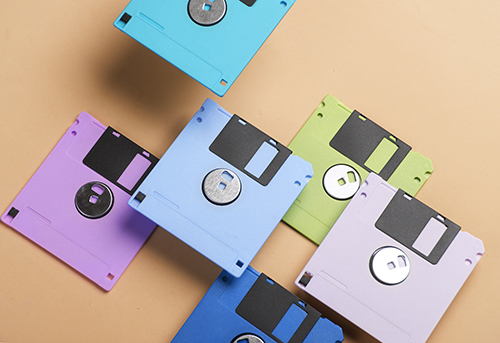
You open a document, change a line and click the little square icon at the top left. Saved. What you just clicked on is the stylized image of a 3.5-inch floppy disk – an object most adults haven’t held in their hands for twenty years.
When was the last time you actually held a floppy disk?
A brief history of a vanished storage medium
The floppy disk has been around longer than most people think. In 1971, IBM introduced the first commercially distributed floppy – a wobbly 8-inch format used mainly in mainframe computers. Today, hardly anyone outside of technology museums has ever seen one.
In 1976 came the 5.25-inch floppy: smaller, cheaper, and genuinely “floppy” – soft enough that you could bend it without immediately destroying it. In the 1980s, it was the standard medium for home computers like the Commodore 64 and the first IBM PCs.
In 1981, Sony released the 3.5-inch diskette – and ironically, that’s exactly the format we all picture today when we hear “floppy disk.” Ironic because this version wasn’t actually floppy anymore. It came in a rigid plastic shell with a small metal shutter protecting the magnetic disk inside. And yet it was still called a “floppy disk” – a name that no longer matched reality.
A typical 3.5-inch diskette held 1.44 megabytes. That sounds like nothing today, and it is: a single photo taken by a modern smartphone is usually three to five times larger. A whole floppy disk wouldn’t even hold one picture.
In the early 2000s, the USB stick arrived and made the floppy disk obsolete within a few years. From 2003 onward, floppy drives gradually disappeared from new computers. Today, you’ll only find real floppies in drawers, in attics, or in the last holdouts of government agencies that simply never updated their administrative software.
Why the icon survived
And yet, millions of people click on the image of a floppy disk every day to save a file. Why has this symbol, of all things, outlived the object it represents?
The answer starts in the early 1980s. When software interfaces with graphical icons came along – first on the Apple Lisa, then the Macintosh, and later on Windows – designers faced a practical question: how do you show someone that this button here writes a document to storage?
A floppy disk is a vivid image. It’s small, square, and unmistakable. For a long time, software tried to mimic real-world objects so they would feel familiar – folders look like manila folders, the trash looks like a wastebasket, the save icon looks like a floppy disk. Anyone who worked with computers in the 80s or 90s had handled real floppies. The symbol explained itself.
Then something interesting happened: the symbol became its own meaning. It no longer represents a floppy disk – it simply is the save icon. Nobody thinks about magnetic disks anymore when they see it. It has become a pure sign, a little hieroglyph everyone understands without knowing its origin.
A generation that has never held a floppy disk uses the icon perfectly correctly. They click on it, the document gets saved, all is well. The shape lives on, the content is forgotten.
Other dead symbols we encounter every day
Once you start paying attention, you notice these survivors everywhere:
The telephone handset. Every smartphone has a green handset for answering a call and a red one for hanging up. The icon shows a classic telephone receiver with its characteristic curve – the bent piece you used to hold between your ear and mouth. You’ll only see receivers like that in old movies or as decorations these days. A smartphone has no handset at all. And yet the symbol is unmistakable: green means “pick up,” red means “hang up.”
The envelope. When you open an email app, you usually see a little envelope. But most people today have barely written a real letter in years. The envelope stands for “message” – even though most messages reaching us have nothing to do with paper or envelopes.
The film camera with reels. In many video apps, the icon for video recording shows an old movie camera with two round reels. Film reels have been all but extinct for years. Even movies in theaters arrive almost entirely digitally now. The symbol stays.
The gear for settings. A gear is a mechanical component from heavy machinery. There are exactly zero gears inside smartphones, apps, or web services. And yet the gear has become the universal sign for “settings” or “configuration.”
The arrow for sending. The paper airplane as a symbol for “send” is a more recent invention – but it too has long since drifted away from anything actually flying through the air.
The audio cassette. In some music apps and on streaming services, you occasionally still see the image of an audio cassette – with its two little reels and brown magnetic tape. Children using these apps have never held a cassette in their lives. Still, they understand immediately: this has something to do with music.

What this says about us
This little collection of dead symbols reveals quite a bit about how we deal with technology.
First: we cling to familiar images, even when they no longer have anything to do with reality. Designers have tried again and again to replace the floppy icon with something more modern – an arrow pointing down at a stylized hard drive, say, or a cloud with an arrow. None of these alternatives caught on in the save department. The floppy disk icon is simply too well understood.
Second: symbols make it easier to bridge the generations. When grandparents and grandchildren both understand the same icon – even if they recognize it for completely different reasons – communication works. The grandfather recognizes the floppy from his working years. The grandchild has simply learned that this little square means “save.” Both click in the same spot. Both understand each other.
Third: it’s a piece of computer history living on inside every word processor. Even if nobody remembers where the symbol came from anymore – it’s there. Like a hieroglyph in an Egyptian temple: a shape with no awareness of its origin, but with a clear function.
What disappears next – and keeps its shape
One interesting thought to close on: which of today’s everyday symbols will be in the same situation as the floppy disk twenty or thirty years from now?
Maybe the USB stick icon, if USB sticks really do get pushed aside by cloud storage. Maybe the image of a laptop, if classic clamshell computers eventually give way to glasses, tablets, or something else entirely. Maybe the Wi-Fi symbol with its concentric arcs, once wireless connections become so commonplace that there’s no point showing them separately anymore.
And maybe the floppy disk icon will still be around fifty years from now. Completely detached from its origin. Nobody will remember what a floppy disk was – but everyone will know what happens when you click on the little square.
It’s fascinating how stubbornly these images persist. They’re little time capsules in our software, reminders of a world that no longer exists. And precisely because nobody thinks about where they came from anymore, they work so well.
What other dead symbols come to mind for you? Do you still have a floppy disk somewhere at home – maybe even with data you can no longer reach? And can you still remember your first one? Let us know in the comments.
Comments
They were the DAYS!!
You've got to love the enthusiasm of the older generation and there toys.
I have some of those ZIP DRIVE things too - as long as they keep running i can very quickly build systems for demonstration and experimentation without any expense.
我が家にある1台の化石化したpcには3・5インチのドライブが付いてます ハハ
--- I do find it interesting that people still often day "dial the phone" even though "touch-tone" phones became common in the 1970s. And on YouTube someone was caught on camera and the person asked "Were you filming that?" Even though there is no film involved, that's a lot easier to say than "Were you "video-ing" me?"
I remember using 8" floppies, Interestingly they survived into the late 90s on some old geophysical equipment
And I remember cutting notches in 5 1/4" floppies to turn the disk over to record both sides - it worked most times.
Also I remember being fond of CP/M, the 6502 and the Z80, so that probably does make me old.
ACHTUNG!
ALLES TURISTEN UND NONTEKNISCHEN LOOKENSPEEPERS!
DAS KOMPUTERMASCHINE IST NICHT FÜR DER GEFINGERPOKEN UND MITTENGRABEN! ODERWISE IST EASY TO SCHNAPPEN DER SPRINGENWERK, BLOWENFUSEN UND POPPENCORKEN MIT SPITZENSPARKEN.
IST NICHT FÜR GEWERKEN BEI DUMMKOPFEN. DER RUBBERNECKEN SIGHTSEEREN KEEPEN DAS COTTONPICKEN HÄNDER IN DAS POCKETS MUSS.
ZO RELAXEN UND WATSCHEN DER BLINKENLICHTEN.
As an addendum: Bill Gates et al. can eat dirt. Preferably dirt containing enriched uranium.
https://www.computerhistory.org/tdih/september/9/
The train.
The moped.
A modern train doesn't run on steam :-)
My old Dell WIN 7 computer still has 3.5" and CD drives, but I have not checked if they work. I use thumb drives to transfer files.
My first computers had 3.5" disks but I was an early adopter. Many times I had to ask for 3.5" disk when buying software because the standard was still 5.25" disks.
A minor correction - the 3.5 inch floppy was indeed 'floppy'. The term refers to the recording medium inside the case, not to the case itself. It contrasted with hard disks, which of course used 'hard' media and had much more storage density and capacity than floppies, even in the early days. But most people never held a hard disk in their hands, and the term was widely misunderstood.
I recall many colleagues referring to 3.5 inch floppies as 'hard disks' and 5.25s as 'floppies' because they did not concern themselves with details such as the internal storage of the computers they used, if they were even aware internal storage existed. They only cared about the disk they stored their own files on (why do we even call them files?) which they transported from computer to computer as needed.
Thanks again!
But. I do still send paper mail 😄
However I still have a working windows 98 desktop that takes floppy and cd.
I use it play a game that only works on that!!
There were a bunch of ladies who get a special paper with your program and bring back, after a while your punched cards. Always with some mistakes. I learned to read the punched cards as after some time they not longer printed anything. I ended punching my cards by myself on a manual punch.
Computer rooms were like a surgeons operating room! They hate me because my 50 something cards took a lot of processing time...
Later I was given at my workplace an IBM XT and I was the only one with a hard drive. 10Mb and I and a technician spent 2 days marking wrong locations from a manufacturer's list. But anyway it was the envy of my coworkers!
Another big annoyance was having to depend on a remote (and overloaded) Calcomp pen plotter (no graphics terminals back then) so that you had to wait up to a week to debug every error!
In those days computer managers were petty kings who jealously guarded their territory. I remember a colleague visiting IBM and asking why all the blue boxes were so empty. She was told that the customers wanted it that way because it made their "empires" look more impressive.
And then the IBM pc arrived and many of these empires disappeared within a few years.
Nov 2016 No article, mag full of other items. Half page bit in adverts about the floppy disk still living on as icon for “Save”.
The article said:-
... The word processor DeScribe, sadly no longer available, was ahead of things: back in 1996 its “Save” icon was an open yellow folder with an arrow pointing from a 'document' into it - not a floppy in sight!
Being of a certain age, I have vague memories of Shugart 8 inch floppies, 5,25 floppies, 2.88MB 3.5 inch discs and the Amstrad 3 inch disc. I remember being sent a 3.5 inch disc with the [OS/2] software for my sound card on it. My ZIP disc unit suffered the "click of death", a stern reminder about the need for reliability in devices used for backup!!
Magnetic reel tape, 10" floppy to the latest.
A short time ago, I read that VHS videotape was being use for backups and it stores for information and was just just as safe as HDD or SSD.
I still have VHS as there are shows, movies and events I have not converted but is always a good idea to have the source available.
I have movies/TV shows on film, VCD, DVD to UHD and digital and upscale for my server.
Hard source is good to have if the digital version ever become too corrupted to repair.
USBメモリは,大容量で便利なのですが,小さくて紛失しやすいというか。
https://www.microbasement.com/hardDrives.html
https://au.headtopics.com/news/old-computer-hard-drives-were-the-size-of-your-washing-80140294
Too bad they do not make 3.5 inch floppy usb drives
Those 'floppy' readers may still be out there, somewhere. I kept one, and it's still functional ...
Nowadays the floppy disc “save” icon is threatened by auto-save.
For example iOS Notes doesn’t have the notion of “saving” (because it auto-saves every change) and therefore no floppy disc icon any more.
Even in office software, auto-save to cloud is on by default, but the icon is still there; maybe it means “force save” or maybe it is just there to satisfy us old souls… :)
Later contracted to a Pac Bell subsidiary editing on IBM PCs and PC ATs using 5 1/2 inch semirigid floppy disks. Technology advanced to 3.25 "high capacity" rigid floppy disks with the metal shutter.
After 40 years as an Emerging Technology Consulting I've used virtually all of the sources of modern icons. There actually were technical guidelines published for designing and adopting icons.
It;s a pleasure to see these symbols help us communicate across generations and technologies.
I do a bit of volunteer work at a local museum and was recently given a box of 3.5 floppies to examine. Some of them had some "interesting" information on them which was saved into the 'modern' digital repository.
About 10 years ago we had a few HP Laptop's that came with a portable USB Floppy Disk reader: When the laptops became obsolescent we fortunately kept a few of the portable floppy readers, and they are still functioning in 2026.
Today portable thumb-drives serve the same function for sharing files across 'unconnected' networks. I hope that in 30/40 years time someone will still be able to read the content of historical thumb-drives from the early 21st century.
・・・使いませんが。
My first brush with computers required the use of paper tape for program use, unless one was prepared to input the commands and functions via switches (in Boolean format of course). This was for a customer application, would you believe.
For personal use, the ZX80 was available on which I even managed to cobble together a spreadsheet. Next for me came Dragon PC with a whacking 32K of storage. Then Fortran, PL1, and various customer-designed software.
Up to this point, there was not really much use of icons, until the first first PC's
using DOS started to arrive, and that's been well-commented on already.
I think flashdrives will survive quite well as an easy and convenient source of
data exchange between friends, etc, probably for longer than any of the other disc drives mentioned in the comments. Oh...and I'm coming up to 85 years.
I think the C64 could se a standart music player/recorder & there was no need for specific datacasette hardware.
The breast pocket on a shirt was actually designed to take a pack of 20 cigarettes however it would also take a floppy disc if it were 3.5 inches
The IBM Personal Computer was introduced/announced one day while we were eating lunch at the factory.